
Your visual schedule will stop working in week two
For the first week, my second-youngest walked past his visual schedule like it was part of the wall.
His first home speech therapist was the one who introduced us to them. He was somewhere between one and a half and two. I printed the cards, cut them out, and put them up in the living room near his toys, down at his height — everything I’d been told to do. He looked at them about as often as he looked at the wall itself.
Then, a couple of weeks in, he pulled the whole thing off the wall.
Here’s the part nobody writes about. When your visual schedule stopped working, that isn’t the end of the visual schedule. That’s most of the process. He’s six now, and in the years since, we’ve started, stalled and restarted that board more times than I can count. The stalls were never the problem. What I did during the stalls was.
Week one, he ignored it completely
This is normal and almost nobody says so.
You’re doing two jobs at once in that first week. You’re teaching a brand-new system, and you’re also trying to use it. Those are different jobs and they fight each other. Your child doesn’t yet know the cards mean anything, so pointing at one and expecting a response is a bit like pointing at a word in a language they haven’t learned.
Week one is not a test. It’s just week one.
The other thing that happens in week one is that you forget. Constantly. For about two weeks I’d remember the board halfway through the thing it was supposed to be helping with. The fix isn’t discipline, it’s placement: put the board where you trip over it, not just somewhere your child can see it.
Then he took it off the wall
My first thought was that he was being destructive. Toddler finds thing on wall, toddler removes thing from wall.
Then I actually watched him.
He wasn’t wrecking it. He was holding it right up close, turning it, going over each card in detail. He carried it around the house with him. He was studying the thing — and I had stuck it to a wall, where he could only ever look at it from wherever I’d decided to put it.
So we changed the object instead of changing him.
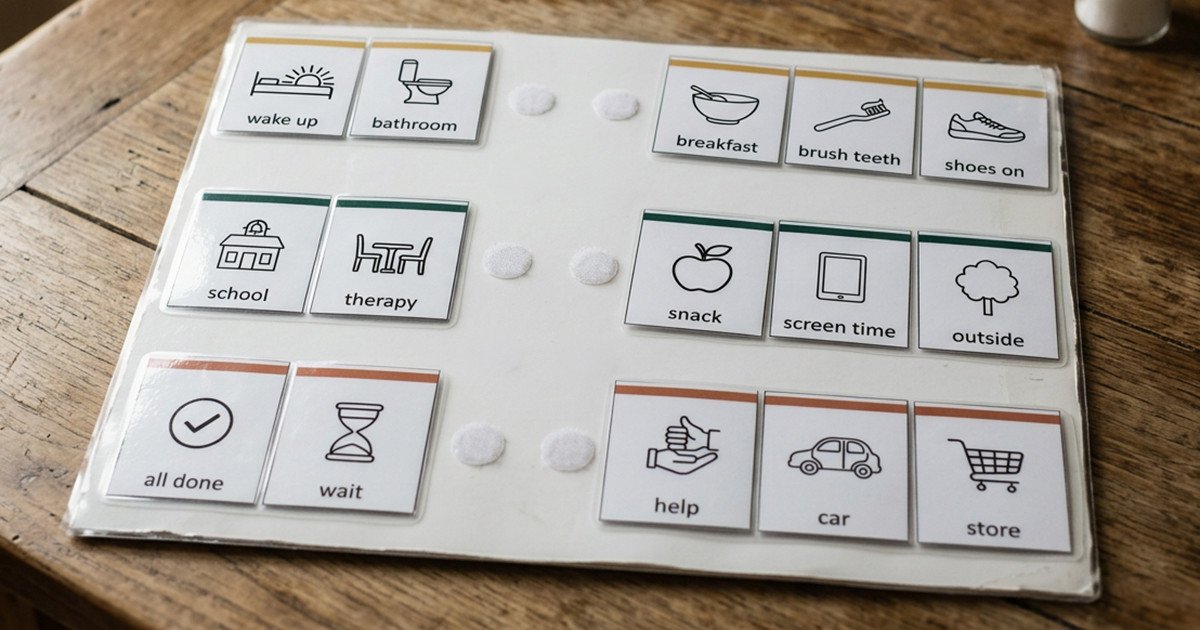
I laminated a piece of cardstock to make a board. I laminated the individual cards too, and put a velcro dot on the back of each one and a strip across the board. That was it. No binder, no special product, nothing that cost more than a pack of self-laminating sheets and a pack of velcro dots.
It became a thing he could pick up and take with him. Which, it turned out, was the whole point.
Worth noticing what happened there. He wasn’t refusing the system. He was telling me something about the system, in the only way available to him. A lot of what gets written down as “it didn’t work” is a kid saying something about how it needs to work.
We started with wants, not with a schedule
This is the part I’d most want to hand to someone starting out, and it’s the opposite of what most guides tell you.
Everything you read says: make a schedule of your child’s day. Morning, school, dinner, bath, bed. And that is what the board eventually became for us.
But it isn’t where we started. We started with choices and wants. Two cards. What do you want — this or this? Point at one, get the thing you pointed at.
Think about what a schedule actually asks of a child. It says: here is what is going to happen to you today, in this order, whether or not you like it. That’s a big ask from a piece of laminated paper your child has no reason to trust yet.
Choices ask for nothing. Choices are the board doing something for him. Point at the card, the thing appears. Do that enough times and the cards stop being decoration and start being useful — and a useful thing is something you’ll pay attention to when it starts telling you what happens next.
We moved to schedules gradually, once the board had earned it. If I were starting again tomorrow with a different kid, I’d do it in that order again.
Then the visual schedule stopped working, repeatedly
Not once. Every so often, for years.
Sometimes there’d be a few good days and then he’d lose interest. Sometimes a few good weeks. It would stop being something he engaged with and start being something he was actively uncooperative about, and there was rarely an obvious reason. The routine had shifted, or the novelty had worn off, or something else in the house had changed, or none of the above.
The first couple of times this happened, I took it personally. I’d think: right, that’s it, this doesn’t work for him, I’ve wasted days of laminating.
It happened often enough that I eventually stopped drawing that conclusion.
What I did instead of pushing
Nothing, mostly. Deliberately.
I left the board up and in sight. I stopped bringing it up. I didn’t prompt, didn’t point, didn’t ask him to use it. I just made sure it stayed somewhere he’d see it if he wanted it.
And then I waited. Usually somewhere between four days and a week before I’d reintroduce it — and often I didn’t have to, because he’d start using it again on his own, just from it being around.
That wasn’t a rule. I didn’t set a timer or read it anywhere. It’s just how it ended up going, because I didn’t want the board to become one more thing that felt like pressure in his day. If it turns into a fight, it isn’t doing its job any more — the entire point of the thing is to make life feel more predictable, not to add another demand to it.
When I did reintroduce it, I usually changed how we were using it rather than trying the same thing harder. Back to choices for a while. Or just one part of the day instead of the whole thing.
Two things worth trying before you decide it doesn’t work
Go back to three cards. Whatever you’re running now, cut it down. Three cards, the part of the day that matters most. A twelve-step chart is a lot to look at even when everything’s going well, and when something’s already fraying it’s just noise.
Swap in a blank. This is the one I’d underline. Use a blank card to make one that’s specifically your house — your actual bathtub, their real backpack, the exact cup. Sometimes a photograph of the real thing works when a drawn icon doesn’t, and that’s not a failure of the icon. Some kids map symbols easily. Some need the actual object first and get to symbols later. Both are fine, and you find out by trying.
What “working” actually looks like
Not a child who happily follows a chart.
It looks like a child who glances at the board when they’re not sure what’s coming. Or who picks up a card and hands it to you instead of melting down, because pointing was easier than the alternative.
It’s much smaller than the version you see on Pinterest, and it’s worth enormously more, because it isn’t compliance — it’s your child having a way to find out what’s happening, or to tell you something, at a moment when they couldn’t otherwise.
The first time it happens you might not even notice. I nearly didn’t.
Where we are now
He’s six. He has an AAC device now, which does most of what the board used to do and a great deal more, so that’s what we mostly use.
But we’re about to print the cards again.
Potty training is the thing we’ve struggled with longest with him — harder and for longer than anything else — and we’re at the point of trying whatever we haven’t tried yet. So the board’s coming back out. One specific routine, a handful of cards, starting from nothing. Same tool, different job, four years later.
Which is really the honest version of all of this. It isn’t a system you set up once and then have. It’s a thing you pick up, put down, and pick up again when you need it.
What’s the transition that goes worst in your house?
Hit reply on any of my emails. I read them all.
Want the visual schedule pack?
Twenty-four routine cards, six blanks, and two ready-to-use routines. Free, and honest about what to expect when it doesn’t work the first week.