At three, it splits in two
In early June 2023, I sat down with the school district about a child who was still weeks away from turning three.
He had been with BabyNet since he was about a year and a half. I first called when he was ten months old and was told to wait, and then I called back. Therapists came to my house. I knew all of them by name. And in a few weeks all of it was going to stop, because that is what happens at three.
Somebody had sat me down and explained that. Our caseworker — the special instructor who had been with us since the beginning — went through what was coming and what I needed to do about it.
I know exactly how lucky that makes me. Nothing in the system guarantees you a person like that. Plenty of families reach their child’s third birthday having been told almost nothing, and then spend the next year finding out what they missed.
And I am going to tell you about the one thing she missed anyway, because that turned out to be the most useful thing I learned in the whole transition.
So here is what happens when early intervention ends, written down properly. Not for one state. The shape of it, the dates that are legally real, and the parts somebody had to tell me out loud.
If the acronyms are what brought you here, there is a plain-language glossary near the end.
What they actually did
The meeting was to set up an evaluation, and the evaluation was bigger than I expected.
He was seen by a team — occupational therapy, speech, physical therapy, the whole group. And then a hearing test and a vision test.
That last part surprises people, and it is worth understanding rather than just complying with. You cannot call something a developmental delay until you have ruled out that a child simply cannot hear you, or cannot see what you are pointing at. A child who is not responding to his name might be autistic. He might also have fluid in his ears. The screening exists so that nobody skips the simple explanation on the way to the complicated one.
The point of all of it was to decide whether he qualified for the district’s special education preschool program for three-year-olds.
He did. He started at the beginning of the 2023–24 school year.
There is a deadline, and it is not a courtesy
Here is the thing I want you to know before anything else in this post.
The school district is required to have an IEP in place by the day your child turns three.
Not started. Not scheduled. In place. That comes from the Department of Education’s own guidance on this transition — children must have “an IEP developed and implemented by their third birthdays.”
There is a second date behind it. The early intervention program has to notify your school district, and hold a transition conference with you, at least 90 days before that birthday. By agreement it can happen as early as nine months before.
And a late start does not move the deadline. If your child is referred very close to their third birthday, the evaluation clock keeps running — but the federal guidance is explicit that a state cannot use its own exception to push the IEP past the birthday. What it asks of districts is every effort to finish by the birthday, or as soon after it as possible. That distinction matters in a meeting. “We got him late, so we’ll get to it” is not a rule. It is an apology.
So the June meeting I walked into was not somebody being kind to me. It was an obligation being met, roughly on schedule.
I was probably told all of this. I had meetings about it, with people whose job was to explain it. But I do not remember it clearly, and I certainly was not holding it in my head as a deadline with legal weight behind it. It was one of fifty things being explained to me in a year when I was not at my sharpest.
That is why it is worth writing down. Not because nobody tells you. Because being told and understanding are two different things, and a date you can look up later is worth more than a date somebody said to you once.
I am not a lawyer and this is not legal advice. Federal rules set a floor. States add to it, and some run tighter timelines than the federal minimum. Mine starts sending notices at 23 months. Yours will differ, and the only way to know is to ask.
But knowing a deadline exists changes the conversation. A parent who knows that an IEP is legally due by a specific date can ask whether it is going to be ready. A parent who does not know just waits, and assumes the silence means everything is fine.
It is not a handover. It is a split
This is the part I got wrong for a long time, and it is the reason I wanted to write this.
I thought turning three meant one program handing my son to another program. Early intervention lets go, school picks up, done.
It is not a handover. One thing becomes two.
The school district takes the education. That is the IEP, the preschool program, the therapy that happens because it helps him access school.
Everything that is not education goes somewhere else entirely — to a different agency, with a different application, a different phone number, and a waiting list of its own.
My caseworker is the reason I knew about it at all. She walked me through what came next — that was what she was there for, in a process that was confusing and unknown and that nobody else was explaining to me.
The second phone call
In South Carolina, that second agency was DDSN — the Department of Disabilities and Special Needs.
Except it is not called that any more. South Carolina has folded DDSN into a new department, and the part that runs these waivers is now the Office of Intellectual and Developmental Disabilities, inside the Department of Behavioral Health and Developmental Disabilities. BHDD-OIDD. Both websites are currently live, which tells you how recent it is.
And South Carolina is not unusual. Washington State renamed its developmental disability services in 2025. Georgia merged its behavioral health and developmental disability departments into a single agency years ago. In some states this work sits inside the mental health department; in others it has a department of its own.
I cannot promise yours will be renamed. What I can tell you is that these names are not stable, and that what your paperwork calls an agency may not be what its website calls it today.
When that happens, say both names. It is not you being confused. It is one office with two names, mid-handover.
Every state has its version of this. California has one, Illinois has one, Missouri has one. They are usually called something with “developmental disabilities” in the name, and they are the agency that runs Medicaid waiver programs. The waivers are how a lot of in-home support gets paid for once early intervention is no longer the thing paying for it.
What it meant in practice for us: we were assigned a new caseworker. A special instructor, the same kind of role we’d had through BabyNet, but on the other side of the line.
His occupational therapy and his speech therapy continued. They did not stop at three and restart at school. They moved.
That is not always what happens, and we were fortunate that it did. Ask specifically whether your child’s therapy carries through the transition, and ask who is paying for it afterward. The answer is not the same everywhere.
That caseworker is the most useful thing we got out of the whole transition, and I will come back to why.
And then you find out it is a queue
We applied for two Medicaid waivers. In South Carolina they are called ID/RD — Intellectual Disability and Related Disabilities — and Community Supports.
My six-year-old went onto the waiting lists in the winter after he turned three. He is still on both of them.
I want to put that next to the national picture, because for a long time I assumed we had been unlucky.
We had not. As of 2024 there were more than 710,000 people on Medicaid home and community-based services waiting lists in the United States. Among the states that reported a figure, the average wait was forty months. Seventy-three percent of the people waiting have an intellectual or developmental disability.
Those lists are not really comparable between states — everybody counts differently, prioritizes differently, and some states do not offer a service at all, so nobody appears to be waiting for it. It is the best national number available, not a promise about your state.
Forty months is more than three years. Join the list the week your child turns three and a wait that long puts you past their sixth birthday.
And it is not a line that moves at a steady speed. My state does not run these lists strictly by the date you applied — there are categories that let a person in a crisis go ahead of a child who has been waiting for years. That is the right way to run it. It also means nobody can tell you where you are, and that “we are nearly there” is not a thing anyone will ever say to you.
That is why this is the most urgent thing in this post. Every other date here is a deadline, and deadlines protect you. A queue does not protect anybody. A queue just moves.
The thing a checklist caught that nobody else had
He should have been on those lists months before he was, and I want to tell you exactly how he ended up on them, because it is the most useful thing in this post.
We had a good caseworker. She had walked me through the transition and told me the second agency existed. And the waiver application still had not happened.
What caught it was a checklist. I got on the phone with Family Connection South Carolina — my state’s parent training and information center — and they went through a list of things families in our position should have done. The waiver waitlist was on the list, and I could not tell them whether we had done it.
I took the question straight back to my caseworker, and her answer is the part I want you to sit with.
She was not sure either. She told me that whoever does the autism evaluation usually adds a child to one of those lists — so she did not know, but she would call and find out.
She called. He was not on them. The person she reached added him that same afternoon.
Nobody refused us. Nobody made a mistake, exactly. My caseworker understood it to be the evaluation team’s step. My state’s own waiver paperwork says a child goes onto the appropriate waiting list once they are found eligible for services — which had already happened, months earlier. Two different beliefs about who does it, and between them, nobody did.
That was February 2024. He had turned three the previous summer. He had been evaluated, found eligible, assigned a caseworker at the second agency, and was moving through his first school year — and he was not on the list he had been sitting out of since the summer.
That is the whole argument for the parent center. Not that they know more than your caseworker. Mine was good — she admitted she did not know, she called the same day I asked, and she fixed it before dinner. It is that they are holding a list, and a list does not assume somebody else already did it.
By the time my four-year-old came through, I knew. I made sure he went on the waitlists, because I had done it the slow way once already.
Two things I did not know, and wish I had
Both are the opposite of what I assumed, and I think the first one cost us time.
You do not have to wait until your child is found eligible before the waiver application goes in.
I believed those were two steps in order — get through eligibility, then join a list. What my state’s paperwork describes is both happening at once. You contact the agency. You are screened. You choose an intake provider who walks you through the eligibility process — and both of my state’s waiver information sheets say the same thing about the application for waiver services: it “can be made at this time.”
At that time. Not after it.
This part I can only infer. Looking at the order things happened in — waiting, then a diagnosis, then catching up on a list we should already have been on — I think I was holding off until the diagnosis was in hand, because I did not know I did not have to. I have no clear memory of deciding it.
What I do know is that I was not the only one who thought that way. When I finally asked, the first answer I got was that the autism evaluation is usually what puts a child on the list. If that is the assumption inside the system, I am not surprised it was mine too.
And you do not have to already be in early intervention. My state’s waiver information sheet says it plainly: early intervention eligibility and services “do not have to be obtained in order to apply.”
And once you do ask, there is a clock on it. In my state the case manager has to submit the request within three working days of you asking for waiver services. That is worth knowing, because it turns a vague “I’ll get to it” into a date you can follow up on.
That is my state’s wording, and yours may say something different. Ask. But ask — do not decide for yourself that you would not qualify. A parent who talks themselves out of applying loses years of queue position for nothing.
And you can be on more than one list at once.
You can only receive services from one waiver at a time — in my state, enrolling in one is listed as a reason your enrollment in another ends. But waiting is different. You can wait on several. We are on both. That is not a loophole; it is how the guidance from my state’s parent center says to do it.
The waivers are not interchangeable. In my state, one of them has an overall limit on what it will spend on a person in a year, and the other does not — and they cover different lists of services. Which one fits your child depends on what their support actually costs, and that is a question for a caseworker, not for me. Ask which is which where you live, and ask before you are choosing under pressure.
Why there was no gap, and why it was not luck
His birthday falls in the summer. School starts in the middle of August here.
On paper that leaves weeks where early intervention has ended and school has not begun — and a summer birthday is the worst version of this. The IEP still has to exist by the birthday. But the services attached to it may not start until the school year does.
We did not have a gap. And I want to be precise about why, because “it worked out fine for us” is useless to you.
It worked out because I had already sorted it with the therapists and the caseworker before it happened. It was arranged in advance, by people who knew it was coming and said so out loud.
That is the whole argument for the caseworker. Not that they bring you services. That they know what is about to happen and will tell you, which means you can set things up before the date rather than after it.
If your child has a summer birthday, ask about the gap specifically. Ask what happens between the birthday and the first day of school, and ask early enough that the answer can still be changed.
The second time was identical
My four-year-old went through the same thing in the summer of 2025. Same evaluation. Same team. Same hearing and vision tests. Same decision at the end of it.
The process did not get easier. I did.
I knew what was coming, I knew the words, and I knew to ask about the second agency instead of waiting for someone to mention it. By then I knew to ask whether he was on the waitlists — and I did not have to. The same caseworker who had not been sure the first time had already submitted the paperwork for both of them. She had learned it too.
I already knew what an IEP was. I’d been doing this with older children for years before the younger two came along.
That is worth saying plainly, because it means my smooth second transition is not evidence that the system works well. It is evidence that I had already paid for the information once, and that one person inside it had learned from the same mistake. That is not a system. That is the same luck, twice.
You should not have to rely on either one.
The words that start getting used at you
Three or four terms show up around this transition and nobody defines them. Here they are in plain language, with the real ones underneath.
FAPE — free appropriate public education. Free, run by the public system, and actually delivered in line with the plan they wrote for your child. “Appropriate” is the word everything gets argued about. It does not mean best.
LRE — least restrictive environment. Children with disabilities are to be educated with children who are not, “to the maximum extent appropriate.” The half people miss is the second half: separating a child out is only permitted when education in a regular class with support “cannot be achieved satisfactorily.” Inclusion is the default. Taking it away is the thing that has to be justified, not the other way round.
Child Find — the duty on school districts to identify, locate and evaluate children who may need special education. One line in it is worth keeping for later: it explicitly covers children who are “advancing from grade to grade.” “But she’s passing” is the most common reason a district gives for not evaluating a child, and the regulation names that excuse and rejects it.
IFSP and IEP — the plan before three and the plan after. The first is built around your family and happens largely in your home. The second is built around school. That difference is not an accident: birth-to-three services are legally meant to happen in what the law calls natural environments, which mostly means your living room. At three, the help stops coming to you and you start going to it.
What I would do this week
If your child is somewhere between two and three and you are trying to work out what happens when early intervention ends, this is the short version.
Find out your state’s transition timeline and write the date down. The federal floor is a conference at least 90 days before the third birthday, and an IEP in place by the birthday itself.
Ask who the second agency is. Not the school. The one that runs your state’s developmental disability services and Medicaid waivers — in South Carolina, that is BHDD-OIDD. If nobody has mentioned one, that is the question to ask out loud.
Apply to it now, even if you are sure you will not qualify. The queue is the thing you cannot shortcut later.
Ask whether you can be on more than one waiting list. In my state you can.
Then ask, in writing, whether your child is actually on it. This is the one I would not have known to tell you two years ago. Being told you will be added, and being on the list, are two different facts. Ask for confirmation, and ask again in six months.
If your child has a summer birthday, ask what happens between the birthday and the first day of school — early enough that someone can still do something about the answer.
Find your state’s Parent Training and Information Center. Free, federally funded, one in every state — mine is Family Connection South Carolina. It is the reason I understood any of the waiver paperwork, and the reason my son is on a list at all.
What I would say to you
The thing I actually want you to take from this is not a date or an acronym.
It is that at three, the number of people whose job it is to tell you things goes down.
Birth to three, somebody comes to your house. They see your child every week. They notice things and they mention them.
After three, the help is mostly the help you ask for.
We still have a caseworker — we chose to keep ours virtual — and she is genuinely useful. But she helps with what I bring her. The school knows about school. The waiver agency knows about waivers. Nobody is watching the whole picture on your behalf.
That is the actual transition. Not Part C to Part B. From being told, to having to ask.
And when you ask and someone says they think it has been handled — ask who handled it. That question cost me nothing and it bought my son a place in a line he had been standing outside of for months.
So ask early, ask more than once, and write down what people tell you.
Did anyone explain the transition to you before it happened, or did you find out as you went?
Hit reply on any of my emails. I read them all.
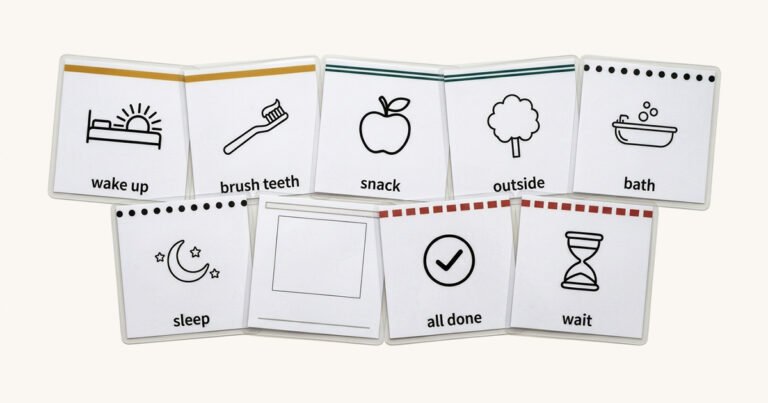
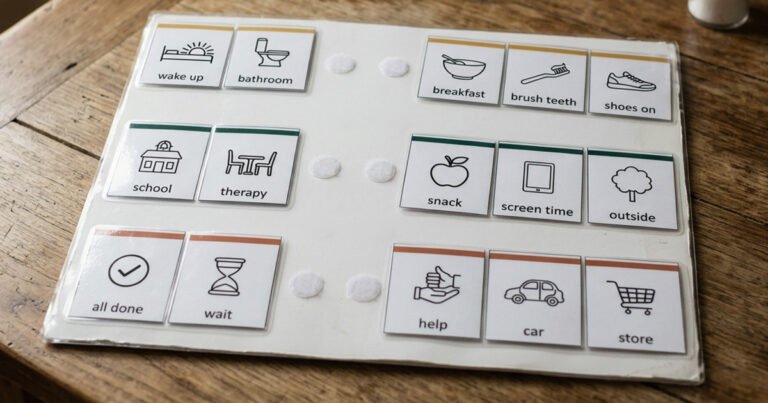
Want the visual schedule pack?
Twenty-four routine cards, six blanks, and two ready-to-use routines. Free, and honest about what to expect when it doesn’t work the first week.