First, then — the board I barely used
A few years in, we heard what sounded like toys being thrown across the room. We went to check.
He was cleaning up. Nobody had asked him to.
I want to back up, because getting there took years, almost none of it looked like progress at the time, and I did it wrong for most of it.
What I was handed, and when
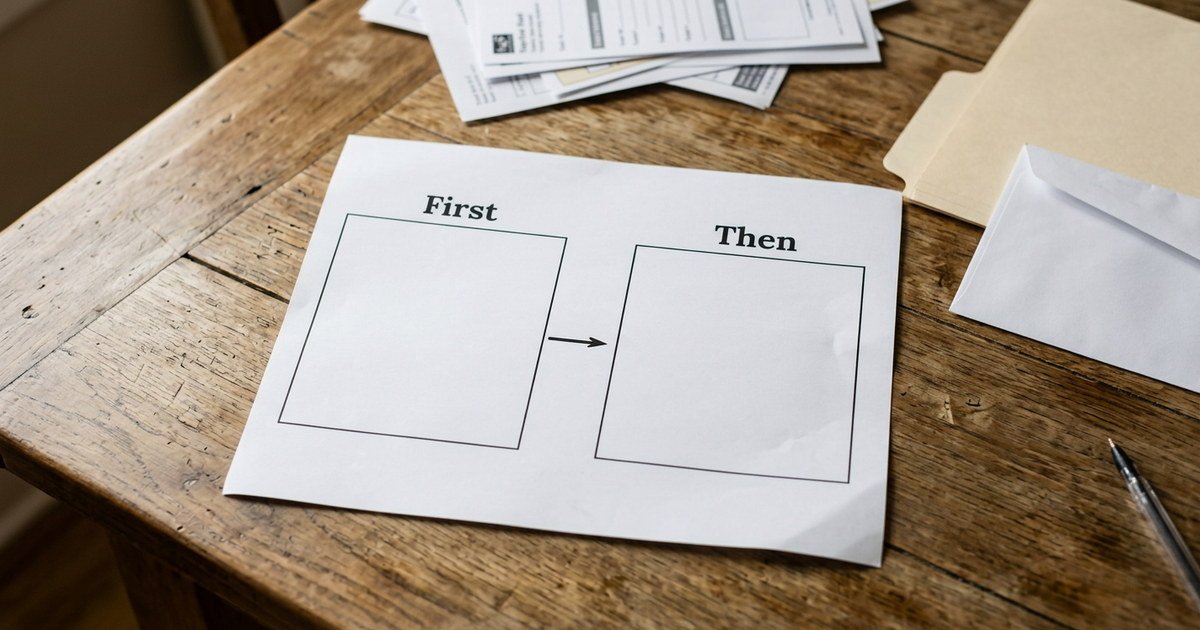
One of the early therapists gave us a first/then board. An occupational therapist or a speech therapist — I genuinely can’t tell you which. I’ve been handed a lot of paperwork and advice over the years.
I can tell you what it looked like. Plain printing paper. Black ink. Two boxes. The kind of thing you’d run off on whatever printer was in the building, which is more or less exactly what I make now.
I couldn’t tell you why they gave it to me either. Probably one more thing to try, something that might get my son helping a bit and give me ten minutes back. That’s a guess. I was not in a state to be taking notes.
Here’s what was actually happening in my house. I’d just had another baby. I was exhausted in the way where you stop noticing you’re exhausted. Breastfeeding around the clock, trying to remember to eat, keeping everyone else moving. Somebody handed me a piece of paper with two boxes on it.
It went on the table. It stayed on the table.
What a first/then board is
Two boxes with an arrow between them. In the first goes the thing that has to happen. In the second goes the thing they already want.
First bath, then book. First clean up, then back to what you were doing.
That’s the entire tool. There’s no step three.
It doesn’t have to be a trade. “First bath, then book” can just mean the order things happen in, not something they earned. Some kids do much better with it that way.
If you go looking for a first then board at home, nearly everything you’ll find is a product page or a classroom resource with a tidy photo. Mine was a loose sheet on a table under a pile of other paperwork.
I barely used it
I never set it up properly. Didn’t laminate it, didn’t put velcro on it, didn’t stick it anywhere. It sat on the kitchen table where I’d see it, and I looked at it the way you look at things when you’re too tired to do anything about them.
Then at some point — I couldn’t tell you when — I noticed I was saying it out loud. First we pick up, then you can go back. Not reading it off the page. Just saying it in that order, because that order had got into my head.
The board’s job, it turned out, was not to teach my son anything.
It was to teach me a sequence. Once the sequence was in me, the paper had done what it came to do.
I think about that whenever I see a parent apologizing for the folder of handouts they never implemented. Having the thing in your eyeline while you survive a hard year is not nothing.
The order is the whole thing
First, clean up. Then, back to what he was already doing. Every single time. Not a threat, not a negotiation, not a reward chart — just the sequence, and only ever for things he’s already allowed to have.
That last part matters. The “then” is never something I’ve taken away and am dangling back at him. It’s what he was already doing and what he’s going to get to do anyway. The order is the only thing I’m holding.
It took years before anything came back
He’s nonverbal. The paper arrived when he was around one and a half. Somewhere in the year after that, without deciding to, I started saying it out loud. By about two and a half it was a real routine, with full hand-over-hand — physically guiding his hands through picking up, every single time, for what felt like forever.
I don’t remember the day it shifted. There wasn’t one.
If you’re six weeks in and seeing nothing, that is what six weeks in looks like.
If your child is nonverbal, say it out loud anyway. Every time. Before you have any reason to believe it’s getting through. I badly underestimated how much he was taking in — receptive and expressive language are not the same thing, and his understanding ran years ahead of anything he could show me.
He didn’t show me it was working for a very long time. Then one day it was toys hitting the bottom of the toy box, and nobody had asked him to.
Where else it works
Baths. Getting in the car. Coming to the table. But the one that runs most often isn’t cleanup at all — it’s shoes.
He comes in from school or therapy and the order is: first shoes off, then play tablet.
He has two tablets and the difference matters. One is his AAC device — that’s how he talks. It isn’t part of this and it never will be. The other is a plain kids’ tablet, purely for fun.
The play tablet is the “then.” His talking never is.
The tablet isn’t a prize I invented to get compliance. It’s what he was going to do anyway the moment he got through the door.
When it doesn’t work
Some days it’s still a fight.
Pushback used to be a short cry and then wanting snuggles. These days he’s more likely to wander off and find something else to do. We let him take the break, go back to hand-over-hand if he needs it, and don’t force the moment. We just hold the order.
A genuinely bad day is different. He cries, loudly, and he bites his hand — that’s his stim when he’s past coping. The chew necklaces that work the rest of the time usually don’t touch it, so he gets his pacifier instead. His dentist sees him twice a year, has no concerns so far, and is fine with it as a comfort.
Then it’s whatever helps. Snuggles, a favorite book, steering him toward something different, or leaving him alone to come down in his own time — often that last one. What’s changed over the years is how fast he gets himself back, and how much of that is his doing rather than ours.
Here’s a recent one. He’d made a mess, and the order was pick it up, then the play tablet comes back. He refused outright, so the tablet didn’t come back.
He melted down for a few minutes. Then he took himself off to his corner of the room with a book, a toy and his pacifier, and he was content. About an hour later, trying a few times along the way, we helped him pick it up.
He didn’t get the “then” without the “first.” Nobody shouted. We didn’t force the moment and we didn’t drop the order. It took an hour instead of a minute.
Where this comes from
First/then is the Premack principle, and it comes out of the same behavioral tradition as ABA. I’d rather name that myself than have someone point it out. There are real criticisms of that tradition and I take them seriously.
My son is in ABA, and so far we’ve been lucky — and I mean lucky, not right. Our team is good. They’re the ones who taught me he has his own autonomy, and who stop me mid-sentence when I say something like he’ll have to live with us forever, to tell me not to set his future in stone.
That’s our facility, not a claim about anyone else’s. Providers vary enormously — ABA, speech, OT, all of it — and you cannot tell a good one from a bad one by looking at a website.
Which is the part I’d say firmly: stay involved, learn to advocate, and watch what actually happens in the room. How you choose a service, and who owns it, is a much bigger conversation than a paragraph. I want to have it here properly.
If you want to try it
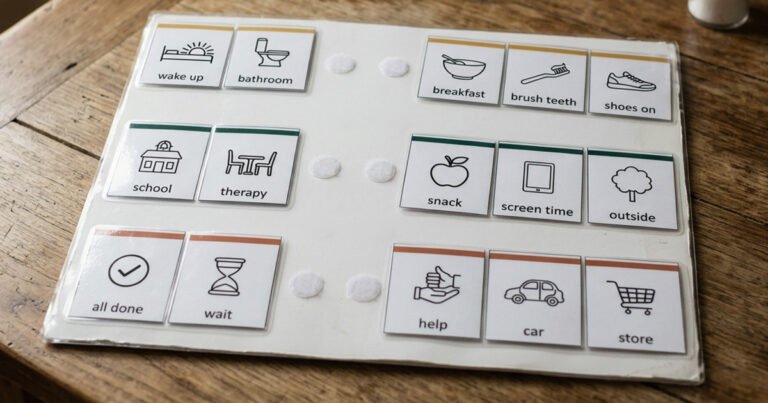
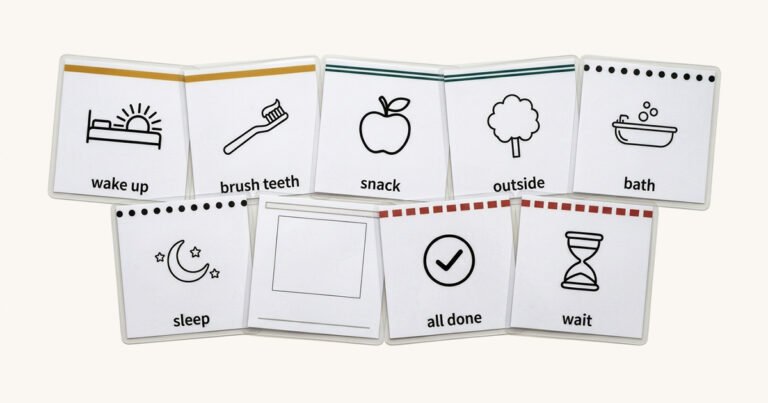
You don’t need to buy anything. Two boxes on a sheet of paper and a pen will do it. If you want one that’s already drawn, there’s a first/then board on page 10 of the free visual schedule pack.
But here’s the version I’d actually suggest, because it’s the one that happened to me: you don’t have to use it with your child at all.
Put it where you’ll see it. Let it remind you to say the words in that order. The sequence getting into your own head is the part that does the work — and your child hears it every time you say it out loud, which is how receptive language gets built, long before anything comes back to tell you so.
If it ends up under a pile of other paperwork for a while, that’s allowed. Mine did. It still worked.
If you’ve already got a board going and it’s stopped doing anything, that’s its own thing and it happens to everyone.
What did someone hand you that’s still sitting on a table somewhere?
Hit reply on any of my emails. I read them all.
Want the visual schedule pack?
Twenty-four routine cards, six blanks, and two ready-to-use routines. Free, and honest about what to expect when it doesn’t work the first week.